Riptide: Tsunamis in Your Browser
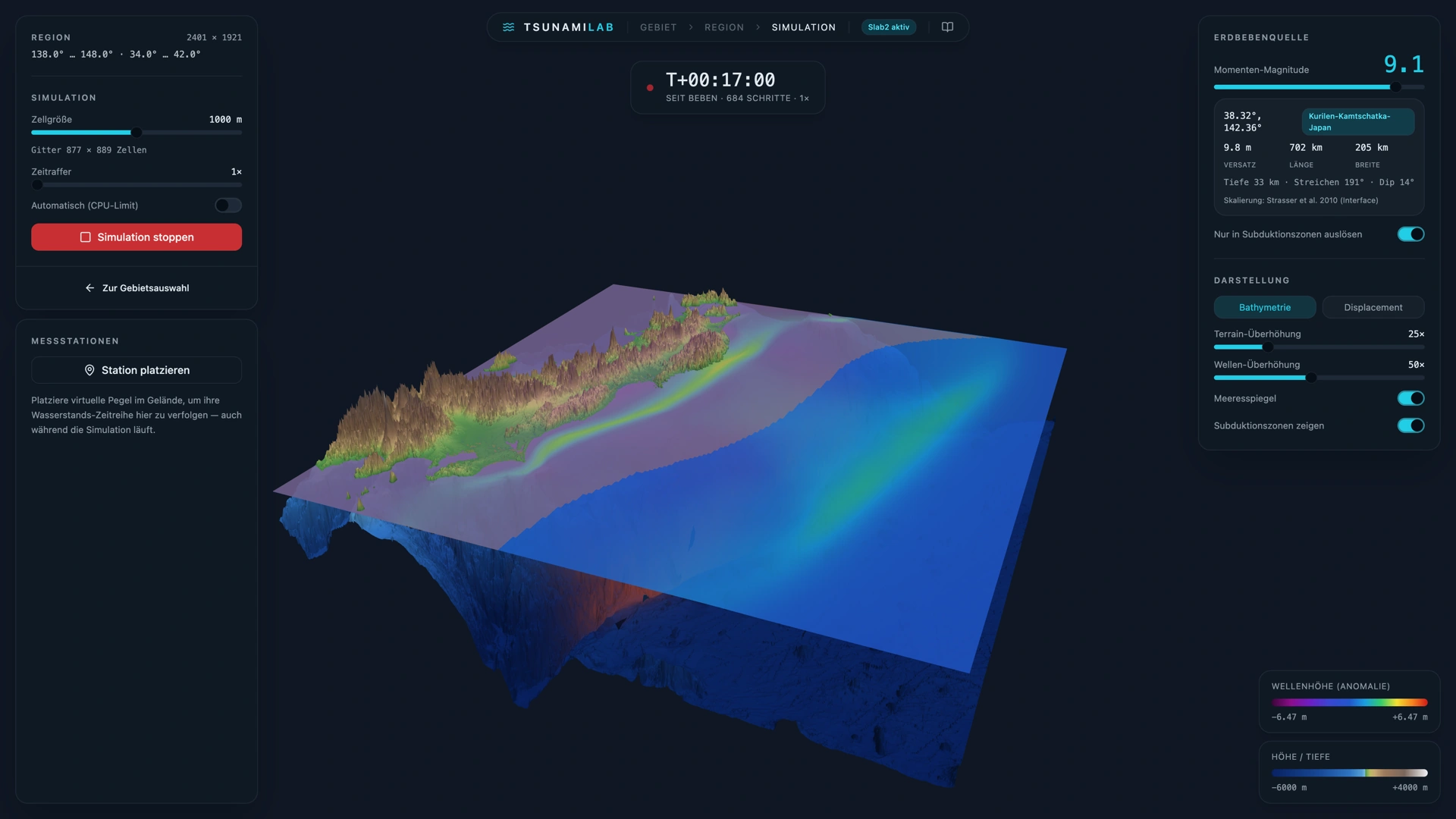
Riptide is a finite-volume tsunami solver that runs as an interactive web application. Tsunami simulations typically run on compute clusters and require specialized software and careful setup. Riptide lowers this barrier: it runs directly in the browser, and a few clicks are enough to explore tsunami scenarios and build an intuition for how earthquakes can generate tsunamis.
Earthquakes can be placed along subduction zones on a 3D globe, and the resulting tsunami can be observed as it propagates within the selected region. Five presets based on historical earthquakes (Tōhoku 2011, Sumatra-Andaman 2004, Valdivia 1960, Maule 2010 and Alaska 1964) provide ready-made starting points, but users can also select their own region. For a closer analysis, they can place virtual tide gauges and follow the recorded water-level time series while the simulation runs.
Riptide’s simulation core is written in C++ and uses an f-wave solver for the shallow water equations. It is compiled to WebAssembly and runs in a background thread. The globe and the simulated waves are rendered with WebGL2, and the interface is built with React. The simulation runs on bathymetry from the GEBCO 2026 global grid, with fault geometry (depth, strike, dip) taken from the USGS Slab2 subduction model. From the chosen magnitude, the app estimates rupture dimensions using scaling laws and derives the average slip from the seismic moment. The Okada model then uses these parameters to compute the initial vertical displacement of the seafloor.
Riptide was developed as a student project by Mika Brückner, Yannik Köllmann and Jan Vogt as part of the Tsunami Lab in the summer term of 2026.